

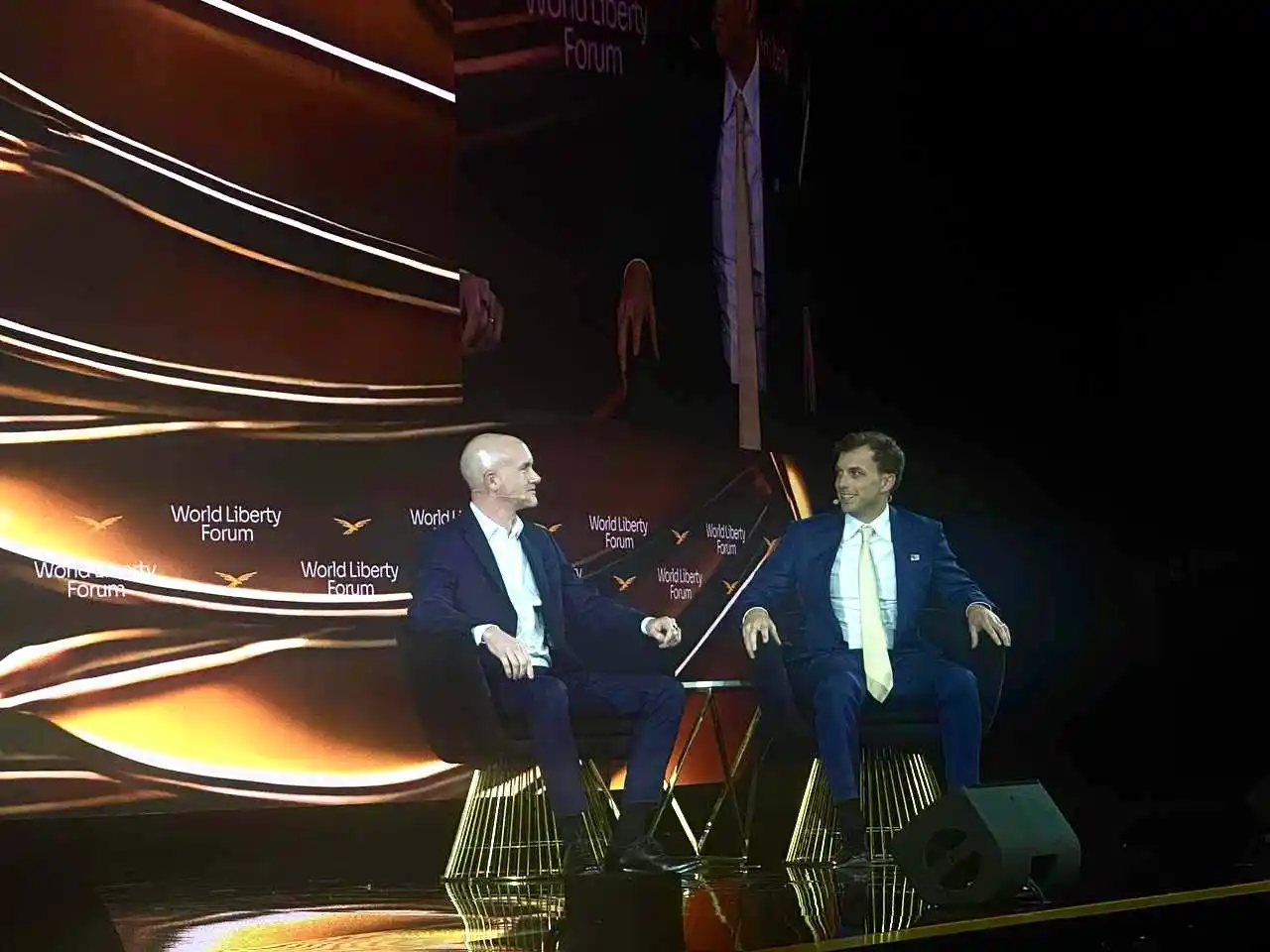
BlockBeats News, February 19, local time in the United States on the 18th, the first World Liberty Forum hosted by the Trump crypto project World Liberty Finance was held at Mar-a-Lago. This forum not only brought together American financial and crypto industry giants and top regulators: Goldman Sachs CEO David Solomon, Coinbase CEO Brian Armstrong, CFTC Chairman Michael Selig, Nasdaq CEO Adena Friedman, Franklin Templeton CEO Jenny Johnson, NYSE President Lynn Martin.
Sports and cultural figures also attended: such as FIFA President Gianni Infantino, renowned rapper Nicki Minaj.
As the organizer, Trump’s two sons Eric Trump and Donald Trump Jr. appeared as hosts.
BlockBeats summarized the key points of the speakers at the event as follows:
Goldman Sachs CEO David Solomon
He shared his first public holding of Bitcoin, but the amount is very small, and stated that he is still a “observer” of Bitcoin, still trying to understand its price behavior and volatility. He emphasized the importance of cryptocurrency to traditional finance and supported the advancement of regulatory frameworks (such as the Senate’s advancement of the crypto market structure bill). Solomon’s appearance marked Wall Street’s shift from skeptics to participants, discussing how the macro environment is conducive to crypto growth by 2026 and hinting that institutions are accelerating their embrace of digital assets.
Coinbase CEO Brian Armstrong
Armstrong stated that the main reason for the deadlock in negotiations on crypto market structure legislation is the Bank Policy Institute, not individual banking institutions. Speaking at the World Liberty Forum held in Florida, he pointed out that some industry associations view the crypto industry with a “zero-sum mindset”, believing that for banks to win, the crypto industry must lose, thereby hindering the progress of the bill.
One of the current controversies is whether to allow stablecoin rewards. After the Senate Banking Committee’s push for the market structure bill was blocked, banking industry representatives in multiple rounds of meetings organized by the White House insisted on restricting stablecoin reward provisions. The next round of relevant meetings is expected to take place this week.
Armstrong anticipates a potential compromise in the future to offer banks new policy benefits in exchange for supporting the bill. He also emphasizes that small and mid-sized banks are truly concerned not about the flow of funds to stablecoin issuers but about the flow of deposits to larger banking institutions. Meanwhile, several major banks have started to enter the crypto space, with Coinbase currently providing crypto infrastructure support for the “Five of the Top Five Global Banks.”
Nasdaq CEO Adena Friedman
As the head of Nasdaq, she focuses on the modernization of financial infrastructure and the integration of TradFi with blockchain. She emphasizes how exchanges are adapting to tokenized assets, stablecoins, and DeFi trends, supporting regulatory clarity to foster innovation. Her speech reinforces Nasdaq’s leadership in the digital asset space, discussing the role of AI in market structure and how to more efficiently integrate crypto opportunities into traditional markets. The overall tone is a proactive embrace of change to drive U.S. dominance in global digital finance.
CFTC Chair Michael Selig
As a regulator, he mainly discusses the progress of cryptocurrency market structure legislation, regulatory pathways, and the CFTC’s oversight role in derivatives/futures. He emphasizes the need to balance innovation with risk control, avoiding overregulation that stifles growth. Selig’s speech is seen as a policy signal, discussing stablecoin regulation, cross-border impacts, and how to make U.S. rules more friendly. CZ was present at the event and mentioned he “benefited greatly” from his speech.
FIFA President Gianni Infantino
Approaching from a sports/global entertainment perspective, he discusses the application of tokenization in the sports industry, such as fan tokens, NFTs, digital collectibles, and how blockchain is reshaping the fan economy and sponsorships. Infantino emphasizes FIFA’s interest in Web3 (having previously launched an NFT project) and explores how to combine football’s global influence with DeFi/stablecoins to create new revenue streams. His participation highlights the forum’s cultural/entertainment dimension, symbolizing crypto’s penetration into mainstream industries.
Nicki Minaj
She participated in the “Owning the Culture: The Business of Music in a Creator-Led Economy” fireside chat (in conversation with Trump advisor Alex Bruesewitz), focusing on how artists are transitioning to entrepreneurs. She discusses transforming music, IP (intellectual property), royalties, and fan communities into on-chain businesses, leveraging blockchain for direct monetization, independent control, and a new fan-driven economic model. Minaj emphasizes the era of creator ownership, where artists no longer rely on traditional record labels but take control of their value chain through crypto/DeFi tools. She also expressed support for Trump, bringing an overall pop culture perspective that attracted significant attention.
Donald Trump Jr.
As the co-founder and host of WLFI, former President Trump’s son, Donald Trump Jr., fiercely criticized the traditional banking system as a “Ponzi scheme,” stating that it forced the Trump family into crypto. He advocates for the USD1 stablecoin as a “Dollar Upgrade,” emphasizing private-sector-driven innovation, stablecoin-driven demand for U.S. debt, and taxpayer assistance.
Eric Trump
He is highly bullish on Bitcoin, predicting it to reach $1 million (based on a historical average annual growth rate of 70%). Eric highlights the Trump family’s crypto initiatives as serving the “most crypto-friendly president,” pushing for regulatory loosening and innovation. He discusses WLFI’s RWA strategy (such as tokenizing Trump Maldives Resort loan yields) and reiterates the family’s vision: upgrading the dollar, bridging TradFi and blockchain, and positioning the U.S. to lead the global financial revolution.


