

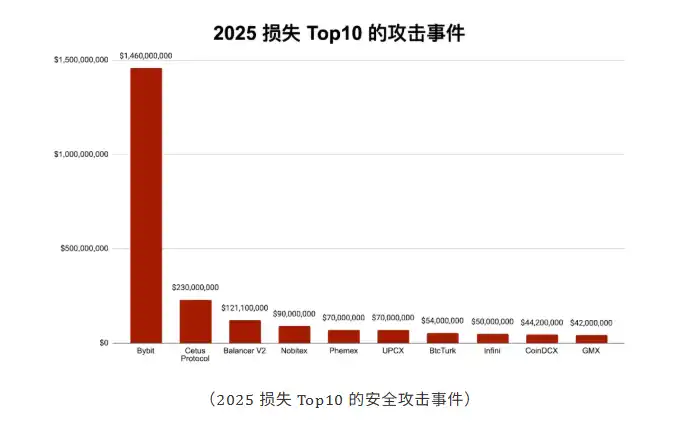
BlockBeats News, December 30th, according to PeckShield’s incomplete statistics, there were a total of 200 security incidents throughout the year, resulting in approximately $2.935 billion in losses. Compared to 2024 (410 incidents, approximately $2.013 billion in losses), although the number of incidents has significantly decreased, the loss amount has increased by about 46% year-on-year.
Looking at the ecosystem distribution, Ethereum remains the most frequently attacked and heavily affected ecosystem, with annual losses of approximately $254 million, significantly ahead in proportion; BSC follows closely behind, with related losses of about $21.93 million; Solana ranks third, with annual losses of about $17.45 million.
Dividing by project track, DeFi projects are the most frequently attacked area: there were 126 security incidents in 2025, accounting for approximately 63% of the total for the year, resulting in losses of about $649 million, a 37% decrease compared to 2024 (339 incidents, $1.029 billion in losses). There were only 12 exchange platform incidents, but they caused losses as high as $1.809 billion, with Bybit alone losing approximately $1.46 billion in a single incident, the most serious event of the year.
Looking at the reasons for the attacks, contract vulnerabilities were the main cause, with a total of 61 incidents; being hacked through X accounts followed closely behind, with 48 incidents.
The report points out that, as Generative AI has accelerated in popularity over the past two years, attackers have also begun to incorporate it into fraud and attack chains. Compared to traditional tools, AI has significantly reduced the cost of fraud in text, voice synthesis, image, and video generation. Attacks no longer rely on rough wording or blatantly abnormal behavior, but rather use highly realistic content, coherent interactions, and precise object selection to make victims more psychologically unaware of the risks.


